
2 hr
Jasper National Park 2-Hour Athabasca River Rafting Adventure
Float a legendary Canadian Heritage River through Jasper's wilderness on a guided, oar-powered raft.
Reserve
Hand-picked by our editors — only the best 5 rafting experiences from 40 reviewed.
Verified partners for every tour, free cancellation where available, and instant confirmation on every booking.
2 hr
Float a legendary Canadian Heritage River through Jasper's wilderness on a guided, oar-powered raft.
Reserve
2 hr
Ride grade 2 rapids through stunning Rocky Mountain scenery on a Canadian Heritage river — no experience needed.
Reserve
3 hr 30 min
Paddle through an untouched canyon on the Athabasca River with thrilling rapids and jaw-dropping scenery.
ReservePrices from verified partners. Availability updates in real time at checkout. Free cancellation policies apply where shown.
The landmarks, rooms, and views travelers on this tour remember — all visible on a single visit.
A powerful waterfall with a 23-metre drop that marks the starting point for canyon runs.
A narrow, steep-walled canyon carved into limestone, offering an intense section of river rapids.
The scenic confluence where the Athabasca and Whirlpool Rivers merge together.
The legendary scenic road that provides access to the river put-in and mountain views.
An expansive, glacially-fed valley that opens up after the canyon stretch.
They complement each other; most visitors who do both call the Sunwapta the more intense experience while the Athabasca river whitewater rafting tour offers superior mountain views. Athabasca river whitewater rafting is ideal for those seeking a balance of landscape photography and mild waves.
| Feature | Top pick Athabasca River | Sunwapta River |
|---|---|---|
Intensity level |
Low to moderate | Moderate to high |
Typical rapid classification |
Class 2 | Class 3 |
Suitability for families |
High | Limited to older children |
Scenery focus |
Expansive mountain vistas | Narrow canyon walls |
Physical effort required |
Low | Moderate |
Best for |
Sightseers and families | Thrill seekers |
| See tickets → |
Verdict: Choose athabasca river whitewater rafting tours if you prioritize scenic exploration, whereas those seeking a faster pace should reserve athabasca river whitewater rafting tickets for the Sunwapta instead.
Choose your ticket, select your date, and reserve in under two minutes. Secure checkout handled by our verified partner.
Instant confirmation by email, with a mobile voucher you can save offline. No printing, no queuing at a collection desk.
Arrive at the entrance, show your voucher on your phone, and walk in. Most tickets include priority or skip-the-line access.
Practical details for your visit straight from our verified partners — hours, access, rules, and how to get there.
Wear a swimsuit or shorts under comfortable clothing for easy changing. Avoid cotton, as it retains moisture and cools the body; wool or synthetic layers are recommended.
Large bags are discouraged, but small zippered backpacks for essentials can be left on the transport bus. Secure valuables in vehicle storage or leave them at your accommodation.
Waterproof cameras are recommended due to the high likelihood of getting wet. Cameras are brought at your own risk; secure them with a wrist strap.
Athabasca river whitewater rafting trips are not wheelchair accessible and require a moderate level of physical fitness. Participants must be able to hold a paddle and sit in a raft.
Children as young as 5 or 6 years old are welcome on designated family-friendly runs. All participants must be able to follow safety instructions from the guide.
No food is provided on the rafting excursion. Guests may bring personal snacks and water in non-glass containers to enjoy after the activity.
Best time to go, insider tips, nearby landmarks, and the cancellation fine print — flip through to skim what matters to you.
Flexible, no hidden fees.
Cancellations are accepted up to 24 hours prior to your trip departure time with a 100% refund. Within 24 hours, the booking is non-refundable.
The Athabasca carries roughly ten million tonnes of glacial silt each year, which is why its water runs pale jade rather than clear. That sediment comes from the Columbia Icefield, some 100 kilometres upstream, where the Athabasca Glacier sheds meltwater into a channel that eventually reaches the Arctic Ocean. It is the longest river in Alberta, and the only major waterway in the province still undammed along its entire length. For centuries the river functioned as a highway. Cree, Dene and Stoney Nakoda communities travelled it long before European contact. In 1811 David Thompson crossed Athabasca Pass, opening a fur-trade route that linked the Columbia district to Hudson Bay, and voyageur brigades hauled goods along these same braided channels for decades afterward. The name itself derives from a Woods Cree phrase describing a place where reeds gather. Canoes gave way to York boats, then to steamers downstream, then to the railway that still runs parallel to the Jasper stretch. Today the section below Athabasca Falls is what draws paddlers. The falls themselves drop 23 metres through a hard quartzite ledge, carving potholes and a narrow slot canyon that the river has been widening since the last glaciation. Downstream of that gorge the gradient eases into a sequence of Class 2 wave trains — lively, cold, and forgiving enough for first-timers. The Sunwapta, a tributary named for turbulent water, offers a steeper and pushier alternative for those who want more. Athabasca river whitewater rafting operators run both, launching from access points inside Jasper National Park with the Colin Range and Mount Kerkeslin standing over the valley. The corridor is part of the Canadian Rocky Mountain Parks UNESCO World Heritage Site, designated in 1984. That status governs how the banks are used: gravel bars remain undeveloped, riparian willow stands are left intact, and elk, osprey and the occasional black bear are visible from water level rather than through a fence. Water temperature rarely climbs above 8°C even in August, fed continuously by melting ice. Much of the river's character is seasonal. Peak runoff arrives in June and July; by late summer the channel narrows and boulders that were buried in spring begin to shape the current. This is why athabasca river whitewater rafting reads differently in August than it does at solstice — same river, different geometry, the mountains unchanged above it.
"The Athabasca is the last major Alberta river left undammed along its entire length."
A step-by-step walkthrough of the visit — what you'll see, how long each stage takes, and the details that matter.
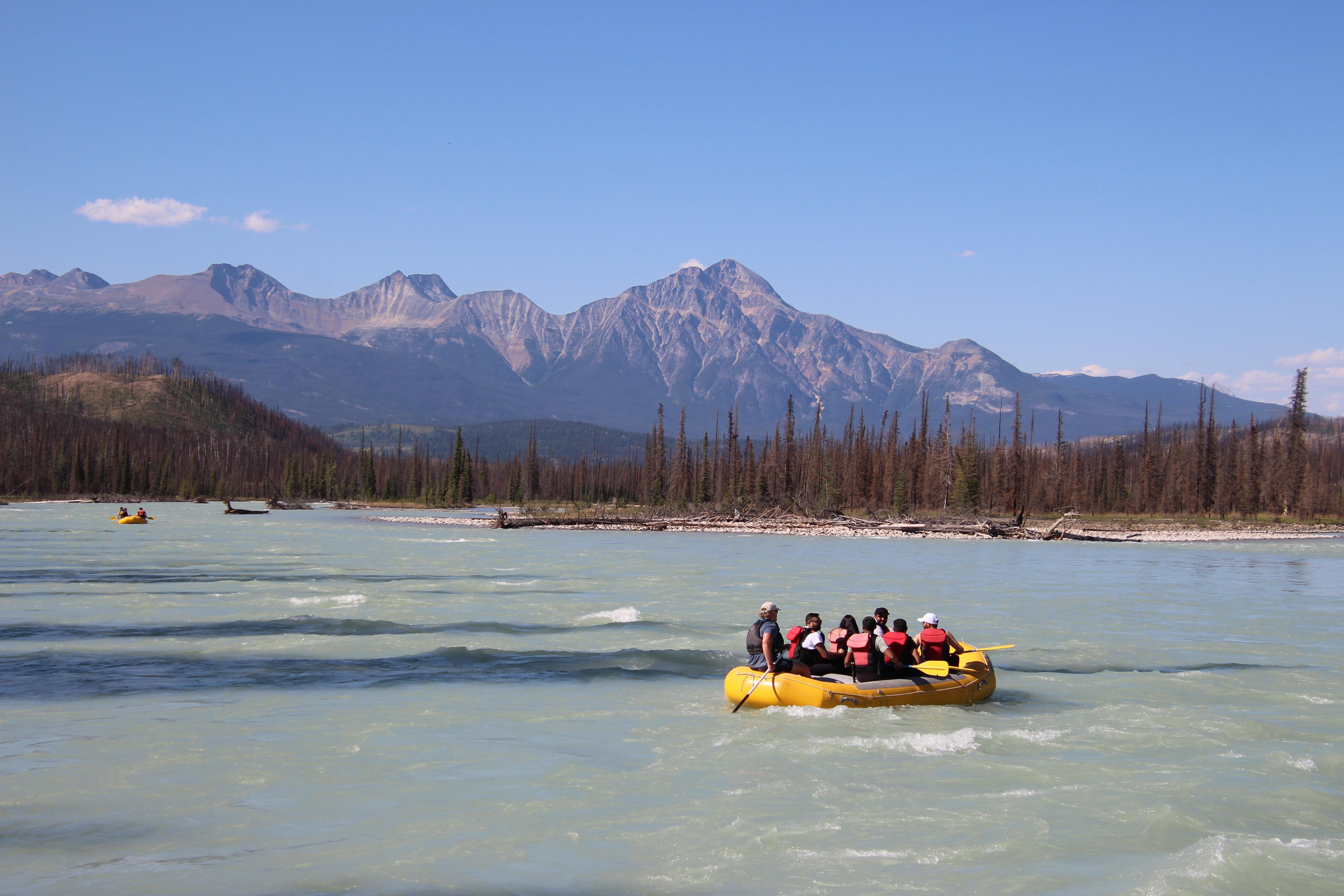
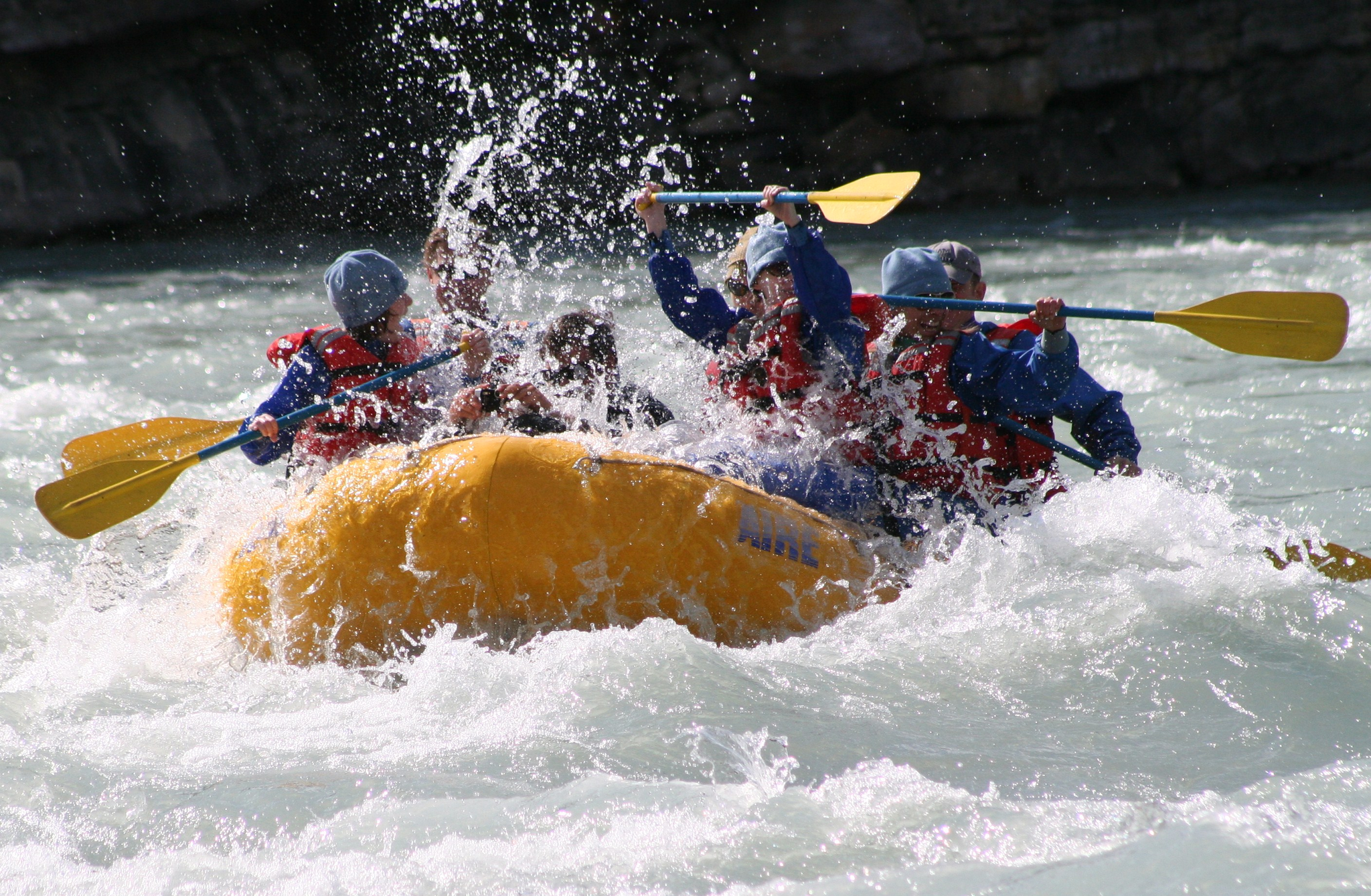
You arrive at the meeting point in Jasper, AB, somewhere in the 09:00–15:30 window that suits river conditions and scheduled departures. There is no gate fee for the river itself — entry is free — though a Parks Canada pass covers the park around it. Staff hand you a wetsuit, splash jacket, booties, helmet and PFD. You change, then queue for the shuttle that runs south along Highway 93A toward the put-in. The safety briefing takes about ten minutes on the gravel bar. You learn three commands, where to wedge your foot, and how to haul someone back over the tube. Then you carry the raft to the edge, step in, and the current takes hold immediately — glacier water, cold enough that you feel it through neoprene. The first kilometre is flatwater. You paddle in rhythm, watching the Colin Range slide past, listening for the low rumble ahead. Then the canyon walls close and the wave trains start: four or five sets of Class 2 water where the raft pitches, sprays and rights itself while everyone shouts. A two-hour athabasca river whitewater rafting trip covers roughly twelve kilometres of this. Between sets the guide points out osprey nests and the cut bank where the channel moved. You drift. Someone tries to spot the bottom through the silt and fails. At the take-out you haul the boat up, peel off wet gear, and ride back with the heaters running.
The best arrival window for athabasca river whitewater rafting is 09:00–15:30 to align with departures and optimal water conditions. Book your athabasca river whitewater rafting tour in advance to ensure availability.
Yes, while the river activity is 0 CAD, a separate Parks Canada pass is required to access Jasper National Park.
Wear a swimsuit or shorts under your clothes; your guide provides wetsuits, booties, and splash jackets for your athabasca river whitewater rafting adventure.
Yes, families are welcome, provided children meet the age requirements of 5 or 6 years depending on the specific athabasca river whitewater rafting run.
The meeting point is at the RV Parking Lot in Jasper, AB. Please arrive 15 minutes early for your athabasca river whitewater rafting departure.
You may bring a phone if it is in a waterproof case, but it is at your own risk during the athabasca river whitewater rafting experience.
Rafting runs rain or shine. Your guide provides professional gear to keep you warm and dry during your athabasca river whitewater rafting trip.
Yes, certified guides provide personal floatation devices for all guests, making athabasca river whitewater rafting safe for all levels.
Nearby attractions include Athabasca Falls and the Icefields Parkway, perfect for visiting after your athabasca river whitewater rafting adventure.